Last reviewed: 7 November 2026
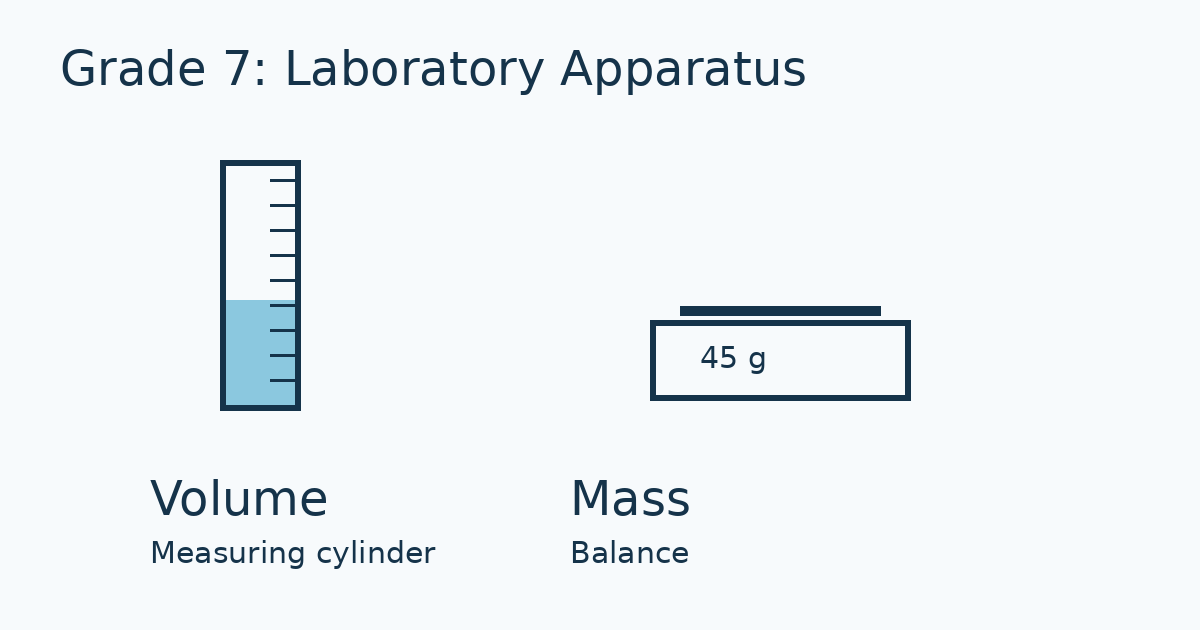
Updated November 2026. These Grade 7 laboratory apparatus notes explain how to choose equipment, read a scale and record a measurement with its unit. A measuring cylinder measures liquid volume, a balance measures mass, a thermometer measures temperature and a stopwatch measures time. The important skill is not just naming an instrument: it is knowing why it suits the task.
This is an original revision lesson, not an official examination paper. Start with the Grade 7 notes hub if you need another subject, or use the Integrated Science revision guide to place this practical skill within your wider revision.
On this page
Grade 7 Laboratory Apparatus Notes: Names and Uses
| Apparatus | Main use | Mistake to avoid |
|---|---|---|
| Measuring cylinder | Measuring liquid volume | Reading the scale from above |
| Beaker | Holding and mixing liquids; suitable beakers can be heated | Treating approximate markings as precise measurements |
| Conical flask | Holding and swirling liquids with less splashing | Using it instead of a measuring cylinder |
| Test tube and rack | Holding small samples; keeping tubes upright | Leaving a round-bottomed tube loose on the bench |
| Balance | Measuring mass | Forgetting to zero it or account for the container |
| Thermometer | Measuring temperature | Confusing temperature with the volume of liquid |
| Filter funnel and paper | Separating an insoluble solid from a liquid | Expecting dissolved salt to stay on the paper |
| Metre rule | Measuring length | Starting at a damaged end instead of a known mark |
| Stopwatch | Measuring a time interval | Recording minutes as though they were seconds |
The distinction between holding and measuring matters. The Kenyan laboratory supplier Sciencelab’s measuring-instrument guide explains why a measuring cylinder is more suitable than a beaker when liquid volume matters.
How Do You Read a Measuring Cylinder?
- Choose a cylinder with a suitable capacity and visible scale divisions.
- Stand it upright on a level bench.
- Pour in water carefully and allow the surface to settle.
- Bring your eye level with the curved liquid surface, called the meniscus.
- For water in an ordinary glass cylinder, read the bottom of the meniscus.
- Record the value and unit together, such as 36 mL.
Looking down or up at a scale can shift the apparent position of the reading. This is parallax error. Moving your eye to the correct height helps prevent it. The bottom-of-meniscus rule here applies to water and similar clear liquids; do not assume every liquid has the same meniscus.
Worked Scale-Reading Example
A cylinder has a mark at 20 mL and another at 30 mL. There are five equal intervals between them. Each interval represents (30 − 20) ÷ 5 = 2 mL. If the bottom of the meniscus is on the third interval above 20, the reading is 20 + (3 × 2) = 26 mL. Count the spaces, not just the printed lines.
Which Units Should You Write?
In school practicals, mass is often recorded in grams, liquid volume in millilitres or cubic centimetres, and temperature in degrees Celsius. Remember that 1 mL = 1 cm³. A measurement without a unit is incomplete: “45” does not tell the reader whether you measured length, mass or time.
For the underlying international system, NIST’s SI units reference lists the metre for length, kilogram for mass, second for time and kelvin for thermodynamic temperature. School use of grams and degrees Celsius does not mean these are the corresponding SI base units.
How Do You Measure Mass Without Counting the Container?
On a suitable digital balance, place the empty container on the pan, press tare and then add the sample. The display gives the sample’s mass. Alternatively, record the empty container’s mass and subtract it from the combined mass.
Original example: a dry cup has a mass of 18 g. The cup and maize grains together have a mass of 63 g. The grains have a mass of 63 − 18 = 45 g. Write the subtraction and unit rather than giving an unexplained answer. Never place wet material directly on equipment that is not designed for it.
A Safe Practical Checklist
Use apparatus only with your teacher’s permission. Check glass for cracks, keep bags away from the working area and report breakages instead of picking up shards. Never taste laboratory substances, smell an unknown substance directly or use a mouth to draw liquid into a pipette. Heating, chemicals and electrical setups require teacher supervision; this reading exercise needs none of them.
For a simple supervised task, measure room-temperature water twice, record both readings and explain any difference. Keep the same cylinder and reading method. Do not invent matching results: observations should record what actually happened.
Original Practice Questions and Worked Answers
- You need 40 mL of water. Beaker or measuring cylinder? Choose the measuring cylinder because it is designed for measuring volume more accurately.
- A balance reads 92 g with a container and 27 g without the sample. What is the sample’s mass? 92 − 27 = 65 g.
- Why is a funnel alone not enough to remove fine sand from water? Filter paper provides the barrier that retains the insoluble sand while water passes through.
- What is wrong with “temperature = 24 mL”? Millilitres measure volume. A suitable temperature reading would use °C.
Next, try the Grade 7 science practice paper. These notes are free. For the site’s paid revision access, choose a KSh 20 Day Pass or a KSh 500 Monthly Pass; check the checkout description before paying.
Frequently Asked Questions
What apparatus measures liquid volume?
A measuring cylinder is suitable for routine school measurements of liquid volume. Choose an appropriate capacity and read its scale at eye level.
Can a beaker measure volume accurately?
A beaker’s markings usually give approximate volumes. Use a measuring cylinder when the task requires a more accurate measured volume.
What is the difference between a balance and a thermometer?
A balance measures mass. A thermometer measures temperature.
Why should a reading include a unit?
The unit identifies what the number represents and allows someone else to understand or compare the measurement.
Ten-minute check: try the free Grade 7 CBC Challenge. It has 10 questions, each marked on the spot with the working, and it shows which topics to practise next.