Printable PDF · 77 A4 pages
KJSEA 2026 Revision Book
- 8 learning areas
- 11 full practice papers
- 426 questions, every answer explained
- 1 week-by-day exam plan
KSh 250 once, by M‑Pesa or card
Also included in the 7-day free trial and every Monthly Pass. Bought it already? Log in.
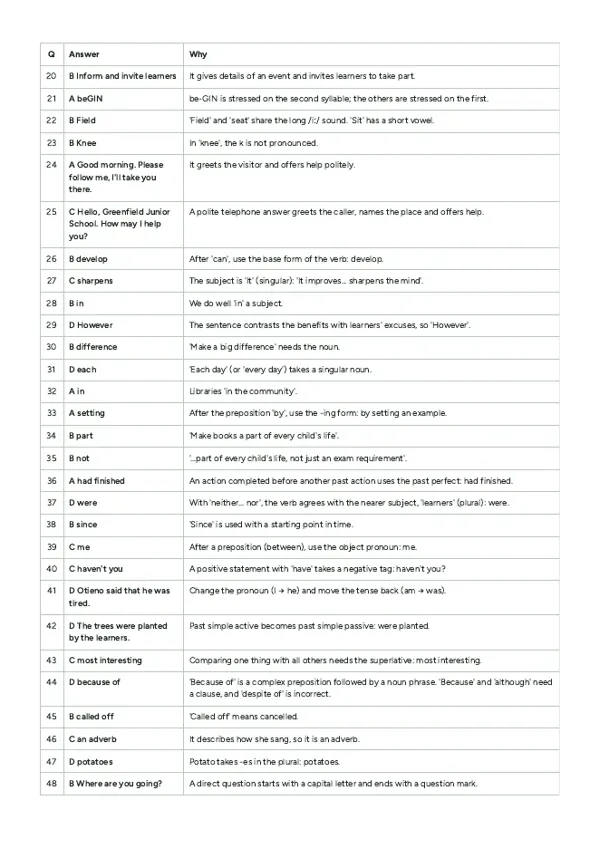
The KJSEA written papers run from Monday 26 to Friday 30 October 2026. This book is for the last stretch: short notes that remind a Grade 9 learner of what keeps coming up, then full practice papers to sit at the kitchen table, with a pen, a clock and no phone. Every answer is at the back with a one-line explanation, so a parent who has forgotten their own school maths can still mark it.
What is inside the KJSEA revision book
- Eight chapters, one per written learning area, in timetable order: English, Kiswahili, Mathematics, Agriculture and Nutrition, Integrated Science, Social Studies, Creative Arts and Sports, and Pre-Technical Studies. Religious Education is not included in this edition.
- Must-know notes at the start of each chapter: the formulas, rules and facts that decide marks, plus a short list of the mistakes that cost Grade 9 learners the most.
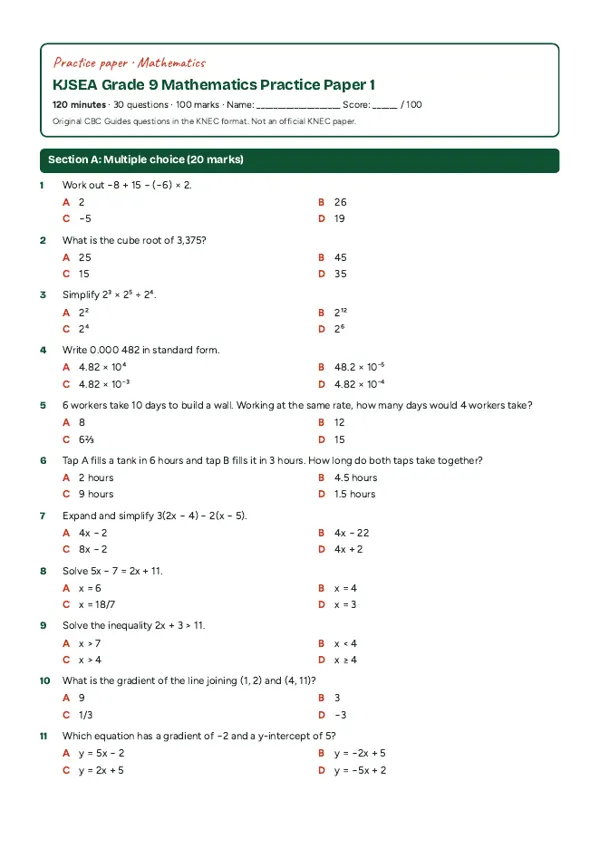
- Eleven full practice papers: two each for English, Mathematics and Integrated Science, and one each for the other five. They follow the KNEC format and timings, with working space for written answers.
- Answers and worked explanations for all 426 questions, at the back so nobody peeks by accident.
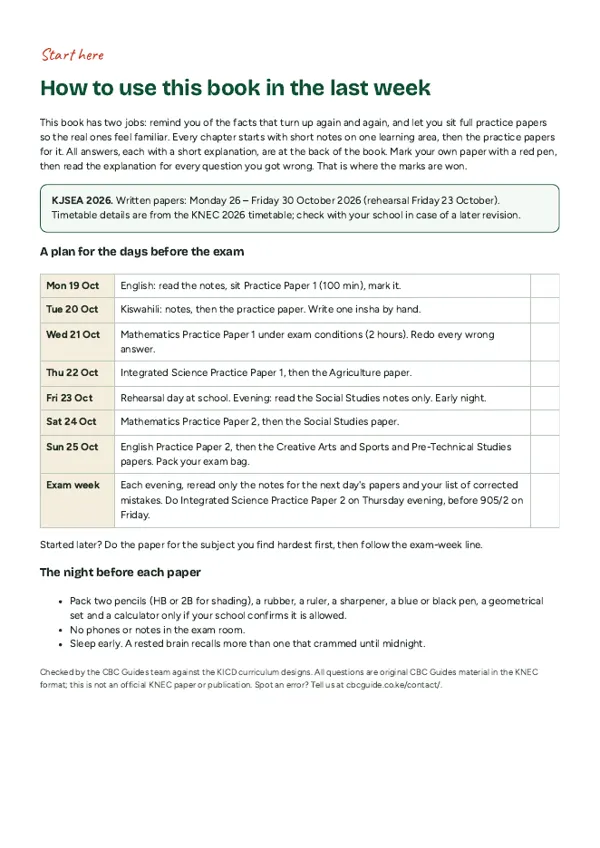
- A day-by-day plan from Monday 19 October to the last paper, a score tracker and a checklist for the night before each paper.
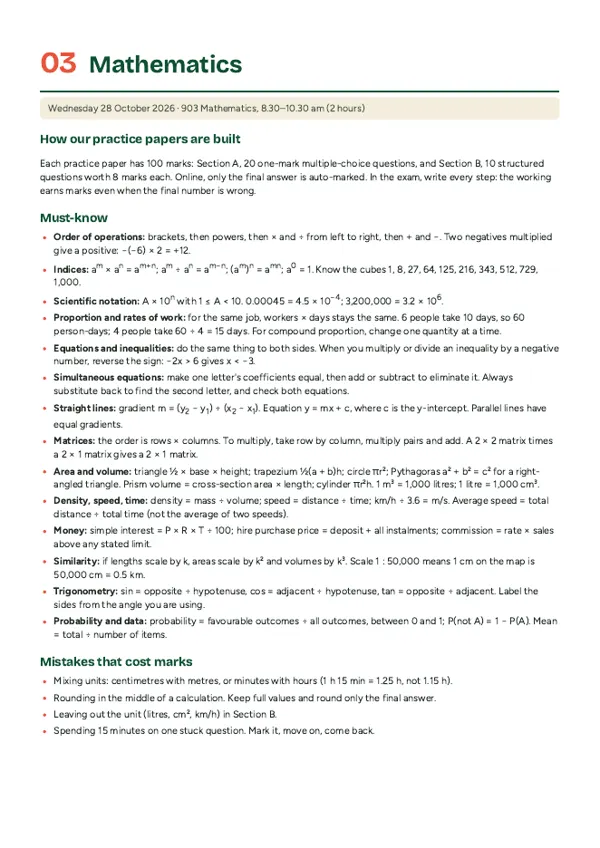
Free sample: Mathematics must-know notes
This is the full notes section from the Mathematics chapter, exactly as it appears in the book. The practice papers that follow it are in the PDF.
- Order of operations: brackets, then powers, then × and ÷ from left to right, then + and −. Two negatives multiplied give a positive: −(−6) × 2 = +12.
- Indices: am × an = am+n; am ÷ an = am−n; (am)n = amn; a0 = 1. Know the cubes 1, 8, 27, 64, 125, 216, 343, 512, 729, 1,000.
- Scientific notation: A × 10n with 1 ≤ A < 10. 0.00045 = 4.5 × 10⁻⁴; 3,200,000 = 3.2 × 10⁶.
- Proportion and rates of work: for the same job, workers × days stays the same. 6 people take 10 days, so 60 person-days; 4 people take 60 ÷ 4 = 15 days. For compound proportion, change one quantity at a time.
- Equations and inequalities: do the same thing to both sides. When you multiply or divide an inequality by a negative number, reverse the sign: −2x > 6 gives x < −3.
- Simultaneous equations: make one letter’s coefficients equal, then add or subtract to eliminate it. Always substitute back to find the second letter, and check both equations.
- Straight lines: gradient m = (y2 − y1) ÷ (x2 − x1). Equation y = mx + c, where c is the y-intercept. Parallel lines have equal gradients.
- Matrices: the order is rows × columns. To multiply, take row by column, multiply pairs and add. A 2 × 2 matrix times a 2 × 1 matrix gives a 2 × 1 matrix.
- Area and volume: triangle ½ × base × height; trapezium ½(a + b)h; circle πr²; Pythagoras a² + b² = c² for a right-angled triangle. Prism volume = cross-section area × length; cylinder πr²h. 1 m³ = 1,000 litres; 1 litre = 1,000 cm³.
- Density, speed, time: density = mass ÷ volume; speed = distance ÷ time; km/h ÷ 3.6 = m/s. Average speed = total distance ÷ total time (not the average of two speeds).
- Money: simple interest = P × R × T ÷ 100; hire purchase price = deposit + all instalments; commission = rate × sales above any stated limit.
- Similarity: if lengths scale by k, areas scale by k² and volumes by k³. Scale 1 : 50,000 means 1 cm on the map is 50,000 cm = 0.5 km.
- Trigonometry: sin = opposite ÷ hypotenuse, cos = adjacent ÷ hypotenuse, tan = opposite ÷ adjacent. Label the sides from the angle you are using.
- Probability and data: probability = favourable outcomes ÷ all outcomes, between 0 and 1; P(not A) = 1 − P(A). Mean = total ÷ number of items.
Mistakes that cost marks in Mathematics
- Mixing units: centimetres with metres, or minutes with hours (1 h 15 min = 1.25 h, not 1.15 h).
- Rounding in the middle of a calculation. Keep full values and round only the final answer.
- Leaving out the unit (litres, cm², km/h) in Section B.
- Spending 15 minutes on one stuck question. Mark it, move on, come back.
How to use it in the last week
Sit one paper a day under exam conditions, using the real time limit printed at the top. Mark it straight away with a red pen, then read the explanation for every wrong answer and write the corrected working underneath. Those corrections are the most valuable pages your child will have on the night before each paper. If you start late, begin with the learning area your child finds hardest, then follow the exam-week evenings in the plan.
Prefer screens? Every paper in the book is also on our Grade 9 revision papers page, where it is timed and marked automatically.
Questions parents ask
Are these KNEC papers?
No. All questions are original CBC Guides material written in the KNEC format and checked by the CBC Guides team. We never sell KNEC papers, and nobody can sell you the real 2026 papers: anyone offering them is a scam.
Do I need to print it?
Printing works best, because the real papers are on paper. A cyber will print 80 A4 pages for a small fee. It also reads well on a phone, with answers written in an exercise book.
Can I share it with other parents?
Please don’t. The licence covers your family. Selling it at KSh 250 is what pays for new papers and free guides on this site. If other parents ask, send them this page.
Is it included in the Monthly Pass?
Yes. The 7-day free trial and the Monthly Pass include this book, the KPSEA book, every holiday pack and every online paper.
My child is in Grade 8. Is it still useful?
Yes, as a preview of what KJSEA asks. Expect a 2027 edition before the next exam season.
Aligned to the KICD curriculum designs and checked by the CBC Guides team. Spot an error? Tell us.