Printable PDF · 40 A4 pages
KPSEA 2026 Revision Book
- 3 learning areas
- 6 full practice papers
- 220 questions, every answer explained
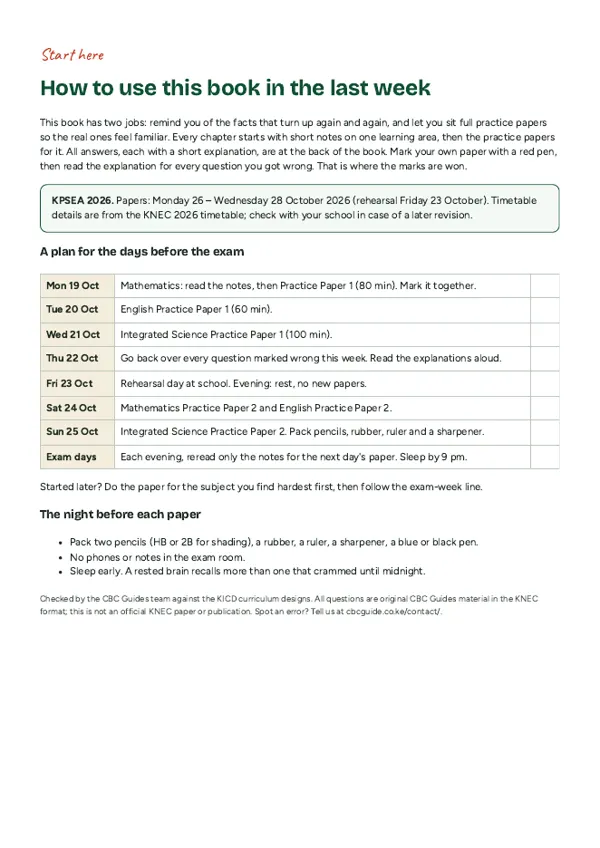
- 1 week-by-day exam plan
KSh 200 once, by M‑Pesa or card
Also included in the 7-day free trial and every Monthly Pass. Bought it already? Log in.
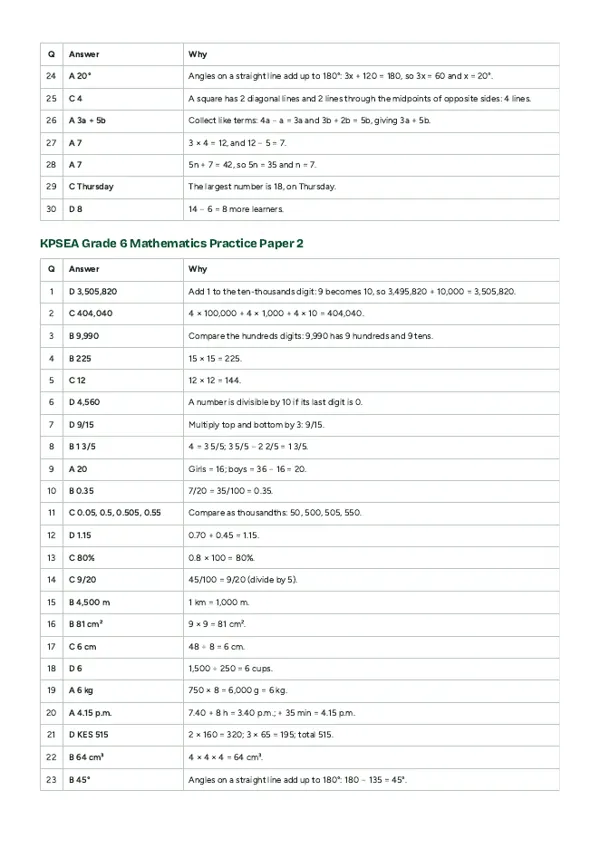
KPSEA 2026 runs from Monday 26 to Wednesday 28 October. This book gives a Grade 6 learner one clear page of reminders per learning area, then two full practice papers each for Mathematics, English and Integrated Science, with every answer explained in words a parent can use to help.
What is inside the KPSEA revision book
- Three chapters in timetable order: Mathematics, English and Integrated Science (Science and Technology, Agriculture, Home Science, and Physical and Health Education). Kiswahili and Creative Arts and Social Studies are not included in this edition.
- Must-know notes for each, written for an 11 or 12 year old, with the mistakes that cost the most marks.
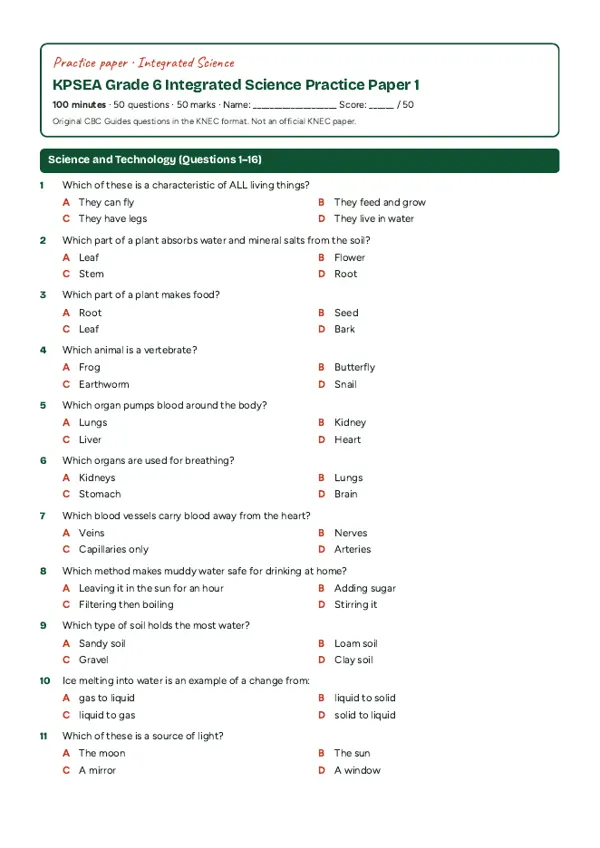
- Six full practice papers in the KNEC multiple-choice format and timings: 30 questions for Mathematics and English, 50 for Integrated Science.
- Answers and explanations for all 220 questions at the back.
- A day-by-day plan for the week before the exam, a score tracker and a packing list.
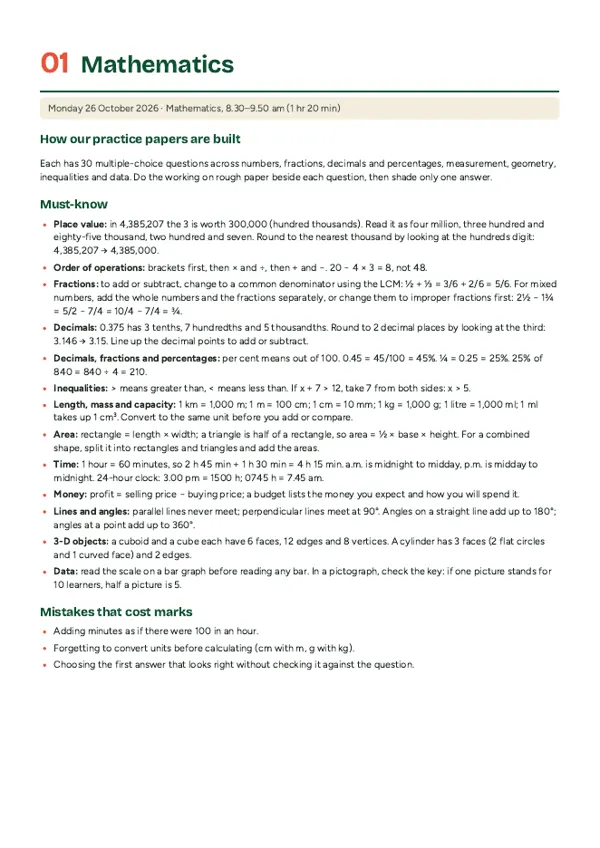
Free sample: Mathematics must-know notes
The full notes section from the Mathematics chapter, as it appears in the book.
- Place value: in 4,385,207 the 3 is worth 300,000 (hundred thousands). Read it as four million, three hundred and eighty-five thousand, two hundred and seven. Round to the nearest thousand by looking at the hundreds digit: 4,385,207 → 4,385,000.
- Order of operations: brackets first, then × and ÷, then + and −. 20 − 4 × 3 = 8, not 48.
- Fractions: to add or subtract, change to a common denominator using the LCM: ½ + ⅓ = 3/6 + 2/6 = 5/6. For mixed numbers, add the whole numbers and the fractions separately, or change them to improper fractions first: 2½ − 1¾ = 5/2 − 7/4 = 10/4 − 7/4 = ¾.
- Decimals: 0.375 has 3 tenths, 7 hundredths and 5 thousandths. Round to 2 decimal places by looking at the third: 3.146 → 3.15. Line up the decimal points to add or subtract.
- Decimals, fractions and percentages: per cent means out of 100. 0.45 = 45/100 = 45%. ¼ = 0.25 = 25%. 25% of 840 = 840 ÷ 4 = 210.
- Inequalities: > means greater than, < means less than. If x + 7 > 12, take 7 from both sides: x > 5.
- Length, mass and capacity: 1 km = 1,000 m; 1 m = 100 cm; 1 cm = 10 mm; 1 kg = 1,000 g; 1 litre = 1,000 ml; 1 ml takes up 1 cm³. Convert to the same unit before you add or compare.
- Area: rectangle = length × width; a triangle is half of a rectangle, so area = ½ × base × height. For a combined shape, split it into rectangles and triangles and add the areas.
- Time: 1 hour = 60 minutes, so 2 h 45 min + 1 h 30 min = 4 h 15 min. a.m. is midnight to midday, p.m. is midday to midnight. 24-hour clock: 3.00 pm = 1500 h; 0745 h = 7.45 am.
- Money: profit = selling price − buying price; a budget lists the money you expect and how you will spend it.
- Lines and angles: parallel lines never meet; perpendicular lines meet at 90°. Angles on a straight line add up to 180°; angles at a point add up to 360°.
- 3-D objects: a cuboid and a cube each have 6 faces, 12 edges and 8 vertices. A cylinder has 3 faces (2 flat circles and 1 curved face) and 2 edges.
- Data: read the scale on a bar graph before reading any bar. In a pictograph, check the key: if one picture stands for 10 learners, half a picture is 5.
Mistakes that cost marks in Mathematics
- Adding minutes as if there were 100 in an hour.
- Forgetting to convert units before calculating (cm with m, g with kg).
- Choosing the first answer that looks right without checking it against the question.
How to use it in the last week
One paper a day is plenty at this age. Sit it at the real time limit, mark it together, and read the explanation aloud for each wrong answer. Praise the corrections more than the score: KPSEA is about showing what your child can do, and confidence matters on the day. Twenty per cent of the KPSEA result is carried forward to Grade 9 placement, so it is worth doing well, but it is not a pass or fail exam.
Every paper in the book is also online, timed and auto-marked, on our Grade 6 revision papers page.
Questions parents ask
Are these KNEC papers?
No. They are original CBC Guides questions in the KNEC format, checked by the CBC Guides team. Nobody can sell the real 2026 papers.
Do I need to print it?
Printing helps because KPSEA answers are shaded on paper, but it also works on a phone with answers in an exercise book. It is 40 A4 pages.
Can I share it?
The licence covers your family. If other parents ask, please send them this page.
Is it included in the Monthly Pass?
Yes, along with the KJSEA book, every holiday pack and every online paper. The 7-day free trial includes it too.
Aligned to the KICD curriculum designs and checked by the CBC Guides team. Spot an error? Tell us.