Last reviewed: 7 November 2026
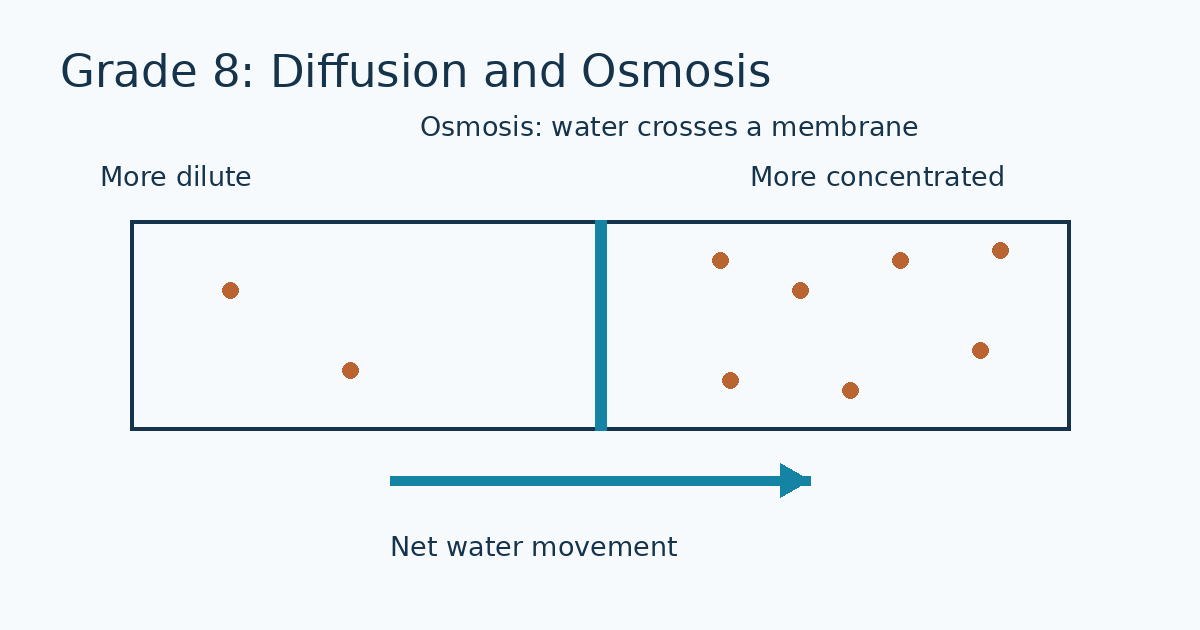
Updated November 2026. These Grade 8 diffusion and osmosis notes explain movement of materials in and out of cells. Diffusion is the net movement of particles from a region of higher concentration to a region of lower concentration. Osmosis is the net movement of water through a selectively permeable membrane from a more dilute solution towards a more concentrated solution.
The questions and worked answers below are original practice, not an official paper. If cell structures are unfamiliar, first read our notes on cells, tissues and organs. For other topics, use the Grade 8 notes hub and the Integrated Science revision guide.
On this page
Grade 8 Diffusion and Osmosis Notes: The Difference
| Feature | Diffusion | Osmosis |
|---|---|---|
| What moves? | Particles of a substance | Water molecules |
| Is a membrane essential? | No; it can occur without one | Yes; a selectively permeable membrane |
| Net direction | Down that substance’s concentration gradient | From more dilute to more concentrated solution under the usual school model |
| Example | Oxygen moving into a cell down its concentration gradient | Water entering a root hair cell from sufficiently dilute soil water |
The word net is important. Particles move randomly in different directions. Where there is a concentration difference, more of the relevant particles move from the crowded region towards the less crowded region than the reverse. At equilibrium the particles still move, but there is no overall movement in one direction.
This explanation follows the distinction made in OpenStax Biology’s account of passive transport. Diffusion and osmosis do not require the cell to spend metabolic energy driving the movement down the relevant gradient.
What Does Concentration Mean?
Concentration describes how much of a substance is present in a given volume. If one cup contains a small amount of sugar and an equal-sized cup contains much more dissolved sugar, the second solution is more concentrated in sugar. It is not enough to compare the total amount of sugar without comparing the volumes too.
In an osmosis question, state which substance you mean. A concentrated sugar solution has more dissolved sugar per unit volume, but a lower concentration of free water than a dilute sugar solution. Writing only “high to low” can therefore be ambiguous. A clearer answer is: water moves from the dilute solution to the concentrated solution through the membrane.
A Simple Diffusion Observation
With an adult or teacher, place a drop of food colouring carefully into a transparent container of still, room-temperature water. Do not stir. Watch whether the colour gradually spreads and record what you actually see. Use food colouring rather than an unknown laboratory chemical, and do not drink the experimental water.
The spreading illustrates mixing without stirring, but do not claim that every visible movement is diffusion alone. Movement of the drop and small currents in the water can also spread colour. If comparing warm and cool water, temperature is the intended variable; equal containers, equal water volumes and equal drops help make the comparison fair. A single kitchen observation is not a precise measurement of diffusion rate.
How Can You Investigate Osmosis With Potato?
- Ask an adult to prepare similar potato strips from the same potato. Learners should not handle a sharp knife unsupervised.
- Label two containers: plain water and salty water. Use equal volumes and enough solution to cover each strip.
- Measure and record each strip’s starting mass if a suitable balance is available.
- Leave both for the same period under the same conditions.
- Remove the strips and gently blot surface liquid in the same way before measuring again.
- Compare the changes and note whether each strip feels firmer or softer.
Potato in plain water commonly gains water and becomes firmer. In a sufficiently concentrated salt solution, it loses water and becomes less firm. The direction depends on the concentration difference relative to the cell contents. Do not assume any amount of salt guarantees the same result.
Worked Example: Interpreting Results
These are illustrative values, not results from a real experiment. Strip A changes from 10 g to 12 g in plain water. Its change is 12 − 10 = +2 g, consistent with net water entry. Strip B changes from 10 g to 9 g in concentrated salt solution: 9 − 10 = −1 g, consistent with net water loss. Blotting matters because water clinging to the surface would add mass without showing water entering cells.
Why Does Osmosis Matter to Plants?
When the surrounding solution is sufficiently dilute, water enters plant cells through their membranes. The cell contents press against the cell wall, helping make the cell turgid. This supports soft stems and leaves. Water loss reduces turgor and can contribute to wilting. The OpenStax discussion of osmosis and plant turgor explains this connection.
A common mistake is saying the cell wall controls osmosis. The selectively permeable cell membrane is the key barrier. The cell wall provides support and helps resist excessive expansion.
Original Questions With Worked Answers
- Does diffusion always need a membrane? No. Particles can diffuse through air or water without crossing a membrane.
- What two details distinguish osmosis in a definition? Water is the substance moving, and it crosses a selectively permeable membrane.
- Why use similar potato strips? Differences in starting size and surface area could affect the comparison.
- Does movement stop at equilibrium? No. Random movement continues, but there is no net movement down a concentration difference.
After answering without looking, try the Grade 8 science practice paper. These notes are free; paid revision access is available through the KSh 20 Day Pass or KSh 500 Monthly Pass.
Frequently Asked Questions
What is diffusion?
Diffusion is the net movement of particles from a region of higher concentration to a region of lower concentration.
What is osmosis?
Osmosis is the net movement of water through a selectively permeable membrane from a more dilute solution towards a more concentrated solution.
Why does potato lose mass in concentrated salt solution?
Water can leave potato cells by osmosis when the surrounding solution is sufficiently concentrated relative to the cell contents.
Is osmosis the movement of salt?
No. Osmosis describes water movement, not salt movement.
Ten-minute check: try the free Grade 8 CBC Challenge. It has 10 questions, each marked on the spot with the working, and it shows which topics to practise next.