Last reviewed: 7 November 2026
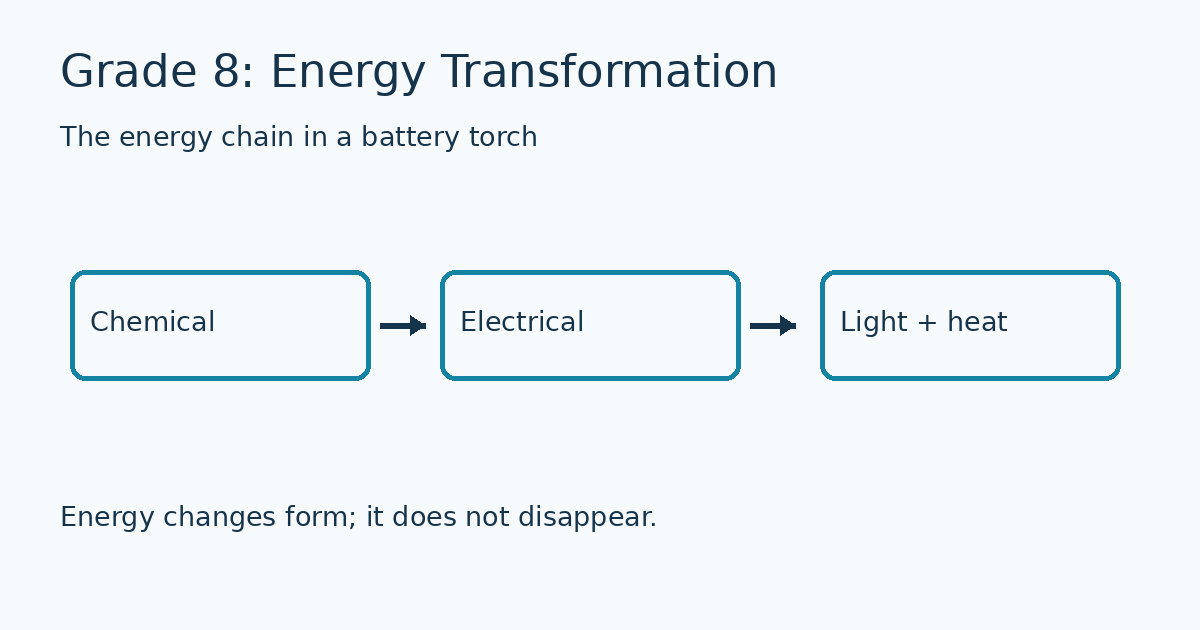
Updated November 2026. These Grade 8 energy transformation notes show how to trace energy changes in a torch, solar panel, cooking appliance and hydroelectric system. Energy transformation means a change from one form of energy to another. A battery-powered torch, for example, changes chemical energy into electrical energy, then into light and thermal energy.
The examples and practice questions are original. Use the Grade 8 notes hub for other subjects and the Grade 8 Integrated Science revision guide for an overview. This lesson develops energy chains in detail rather than replacing the whole science course.
On this page
Grade 8 Energy Transformation Notes: Forms of Energy
| Form | Meaning or identifying feature | Example |
|---|---|---|
| Kinetic | Associated with motion | A rolling ball |
| Gravitational potential | Associated with position in a gravitational field | Water stored high behind a dam |
| Elastic potential | Stored when a suitable object is stretched or compressed | A stretched spring |
| Chemical | Stored in substances and released or transferred in chemical changes | Food, fuel or a battery |
| Electrical | Transferred in an electric circuit | A circuit supplying a fan |
| Light | Energy carried by visible electromagnetic radiation | Sunlight reaching a solar panel |
| Thermal | Associated with the internal motion and interactions of particles | Warm water in a cup |
| Sound | Energy carried by vibrations through a medium | A loudspeaker producing sound |
The U.S. Energy Information Administration’s energy explanation describes these broad forms and how energy changes form in everyday activities. “Heat energy” is common school wording; more precisely, heat is energy being transferred because of a temperature difference.
How Do You Write an Energy Chain?
- Identify the starting store or source: battery, fuel, food, moving water or sunlight.
- Name the device or process doing the conversion.
- Write the forms in order, using arrows to show the changes.
- Add useful and less-useful outputs where relevant.
Use forms of energy on the arrows, not a mixture of device names and energy forms. “Battery → bulb” names components but does not explain a transformation. “Chemical → electrical → light and thermal” explains the chain. You can write the component names underneath to show where each change takes place.
Example 1: A Battery Torch
Chemical → electrical → light + thermal. Chemical reactions in the battery supply electrical energy to the circuit. The lamp gives light, with some energy also transferred as heating. A battery is not a store of “light energy”, and the wires do not manufacture energy.
Example 2: A Solar Panel and Rechargeable Lamp
During charging: light → electrical → chemical, as energy is stored in the rechargeable battery. During use: chemical → electrical → light + thermal. A solar water heater is different: it primarily uses solar radiation to heat water. Do not give the photovoltaic panel’s energy chain for every solar device.
Example 3: Hydroelectricity
Gravitational potential → kinetic → mechanical rotation → electrical. Water at height flows down, turns a turbine and drives a generator. The EIA’s hydropower guide explains this water–turbine–generator sequence. A generator converts energy; it does not create energy from nothing.
Example 4: Cooking and Moving
In an electric kettle, electrical energy is transferred mainly into heating the water and kettle, with some warming the surroundings. In a runner, chemical energy from food supports movement and thermal transfers. In a charcoal stove, chemical energy becomes mainly thermal energy and some light. Never demonstrate combustion indoors merely for revision: observe diagrams instead.
Is Any Energy Lost?
Energy is conserved: it cannot be created or destroyed in an ordinary energy conversion. But not every output is useful for the task. A fan is intended to move air; sound and heating may be less useful outputs. Saying energy is “wasted” means it is dispersed into forms less useful for our purpose, not that it ceases to exist.
Original numerical example: a hypothetical device receives 100 J. Of this, 65 J becomes the intended useful output and 35 J is transferred to the surroundings. The accounting is 65 + 35 = 100 J. These are teaching numbers, not a measured efficiency claim about a real product. The unit joule, symbol J, measures energy; a watt measures the rate of energy transfer.
Renewable Sources Are Not the Same as Energy Forms
Sunlight, wind and flowing water are examples of renewable sources. Coal, oil and natural gas are non-renewable fuels on human timescales. “Renewable” describes replenishment of the source, while “electrical” describes an energy form or transfer. Electricity can come from either renewable or non-renewable sources, so electricity itself should not automatically be labelled renewable.
Similarly, a rechargeable battery stores energy supplied during charging; it is not an inexhaustible primary source. It eventually needs recharging, and the charging electricity has its own source. This distinction helps explain why two devices with the same electrical output can have different supply chains.
A Safe Observation Task
Choose three familiar devices without opening them: a torch, a hand-operated sharpener and a solar calculator. Make columns for input, useful output and other outputs. Describe what you can observe, then label what you infer. Do not dismantle batteries, touch mains wiring, place fingers in fans or touch a hot bulb. No live electrical construction is needed for this lesson.
Original Practice Questions and Worked Answers
- A speaker makes sound. What is the main conversion? Electrical energy is transferred into sound, with some thermal output.
- Why is “a generator creates energy” incorrect? It converts energy, commonly mechanical rotation into electrical energy.
- A device receives 80 J and gives 50 J useful output. How much goes to other outputs? 80 − 50 = 30 J, assuming these account for all outputs.
- Why is an electric kettle not evidence that electricity is a fuel? Electricity transfers energy to the kettle; the primary source depends on how the electricity was generated.
Apply these ideas in the Grade 8 Integrated Science practice paper, or revise another force topic with our pressure notes. These notes are free. The paid revision options are a KSh 20 Day Pass and a KSh 500 Monthly Pass.
Frequently Asked Questions
What is energy transformation?
Energy transformation is a change from one form of energy to another.
What energy changes take place in a torch?
A battery torch changes chemical energy into electrical energy, then into light and thermal energy.
Does wasted energy disappear?
No. It is transferred into forms that are less useful for the intended task, often warming the surroundings.
Is electricity always renewable?
No. Electricity can be generated using renewable or non-renewable sources.
Ten-minute check: try the free Grade 8 CBC Challenge. It has 10 questions, each marked on the spot with the working, and it shows which topics to practise next.